
Description
THIS DOUBLE BASS HAS BEEN SOLD, THE PAGE HAS BEEN TURNED INTO MY ACCUMULATED INFORMATION ABOUT ALUMINUM DOUBLE BASSES STARTING IN 2005.
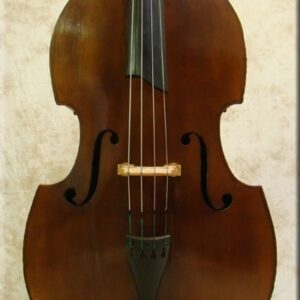
Aluminum Double Bass labeled G. A. Pfretzschner
Aluminum double basses are rare today, and little is known about them. Not much information can be found on the very earliest possible makers…and even the companies that we can confirm made
them do not know much, if anything about them. There are various different legends about who, when and where they were made. Perhaps this listing will prove to be as much educational as it is interesting.
First some facts:
In 1891 Alfred Springer of Cincinnati, Ohio, was awarded a patent for an aluminum violin. There are no known double basses to have been produced from the Springer workshop.
In 1894 the Aluminum Musical Instrument Company of Ann Arbor, Michigan offered everything from violins to zithers. By 1898 however, the company was no more. We are not aware of any double basses being made by this workshop and given the short amount of time they were in business, it seems unlikely, but as the range of instruments they produced was so vast, it is still probable.
During the 1930?s (the Aluminum Double Bass Patent was issued in 1932) the Aluminum Company of America (ALCOA) produced aluminum upright basses (From 1929 To 1934). The entire body, neck and scroll were made out of seamlessly welded aluminum and were often covered with a convincing (from 20 feet!) faux wood grain finish. Information suggests that only 500 double basses were made. To find one of these basses today with it’s original finish in pristine condition is rare as most are well worn or have been sandblasted.
The original patent can be viewed here.
The USA was not alone though in the production of Aluminum instruments. The G.A. Pfretzschner workshop of Markneukirchen, Germany was also producing a number of aluminum cellos and double basses for import into the USA. Although all surviving aluminum basses are rare, these are the more
common and what most people have seen. To date I know of both a flat back model and a arched back model, although the arched backs are more common. The Europeans used spruce bass bars, blocks and sound post platforms as well as Maple necks. I have found little in my research about these basses creation. Actual companies making the basses and the dates of manufacture are not currently known to me…although as of the Fall of 2009 I am waiting to hear back if the Rubner company had a hand in making them. This is plausible to me as Rubner has metal working capabilities and the Pfretzschner workshop is well known for buying instruments from various German sources for export to the USA.
Now for the Legends!
An all too often told story is that the Ford Motor Company or Colman produced a limited number of aluminum basses for the Navy & U.S.O. as a wooden bass could not survive extended travels on the ships as they are highly susceptible to humidity and moisture. This is on the level of urban legend. The Ford Motor Company never made a single double bass. I have had lots of conversations with various Ford Archivists and I have letters from the Ford Motor Company confirming that they never made a double bass or any musical instruments. Most of the German made basses are falsely attributed to Ford. The only linking evidence of Colman making Double Basses is the ALCOA plant that made the double basses was located in Buffalo, NY where Aluminum Coleman products are now made by ALCOA. Now onto the Theory that they were made for the U.S.O. I’m opening many cans of worms on the date WWII started, but it could be anywhere from 1937 to 1941 depending how you look at it. Regardless, the patent issued to ALCOA for an aluminum double bass was 1932. Now having a patent ourselves and understanding the process, I can take a leap that ALCOA was making double basses prior to 1932. So ALCOA making basses exclusively for the U.S.O. use in WWII seems unlikely. Also take note that once the USA entered WWII precious metals and materials were in scant supply and
most manufacturers who had the abilities re-tooled factories to make Military contracted goods. It is likely that ALCOA scraped the instrument production in favor of high paying government contracts. So although a few Aluminum Double Basses might have been on tour with the U.S.O. in WWII it is in all likeliness WWII itself that stopped these basses being made!
So you have an Aluminum Double Bass and want to know what you have?
American made Aluminum instruments are unique in the fact that they were seamlessly welded whereas the Europeans used rivets & screws. This single tell-tale identifier can be used to spot one from across the room. The Europeans used spruce bass bars, blocks and sound post platforms as well as Maple necks whereas the American made instruments are entirely aluminum. It is our opinion that the European made basses, due to their construction, have a much better tone. The rivets allow luthiers the opportunity to disassemble the instruments for maintenance and repairs when needed. The American made ALCOA basses are far stronger though and can withstand the rigors of time (and abuse) much better.
This bass bears it’s original label and is from the Pfretzschner workshop.


We have been asked many times over the years what these basses are worth. Our reply is often “whatever the market will bear”. Please keep in mind though, this is not a rare, untouched Prescott…this is an German made aluminum bass…and the price should be in the neighborhood of an Kay in similar
condition.
Since publishing this page in February of 2005 I have been dismayed to see others take from my research. I have seen my research reproduced both electronically and in print. It may seem petty to state these facts, but I put a lot of time and energy into finding out more about these instruments and it is a shame to see this hard work taken without acknowledgement. – Eric


Clifford Lueck –
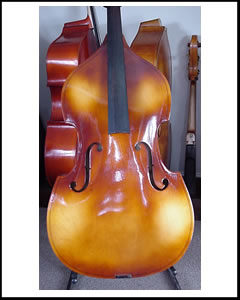
Good evening: At age 59 I visited with a good friend’s Uncle and Aunt and he showed me his Aluminum Bass. I said”you have got to be kidding”. He wasn’t kidding. This is the first time I have ever seen an Aluminum Bass. It has the rivets and screws with the maple neck, so it must be from Markneukirchen, Germany. I was simply amazed at the sound of this instrument. It has a very deep bass sound with an arch top and back. The tailpiece was wood. The owner states it was over 60 years old. It came from a former small Lutheran College. The fingerboard was made from Ebony. The tuners were really nice. Just an amazing piece of History. I wish I knew more about Aluminum Basses.